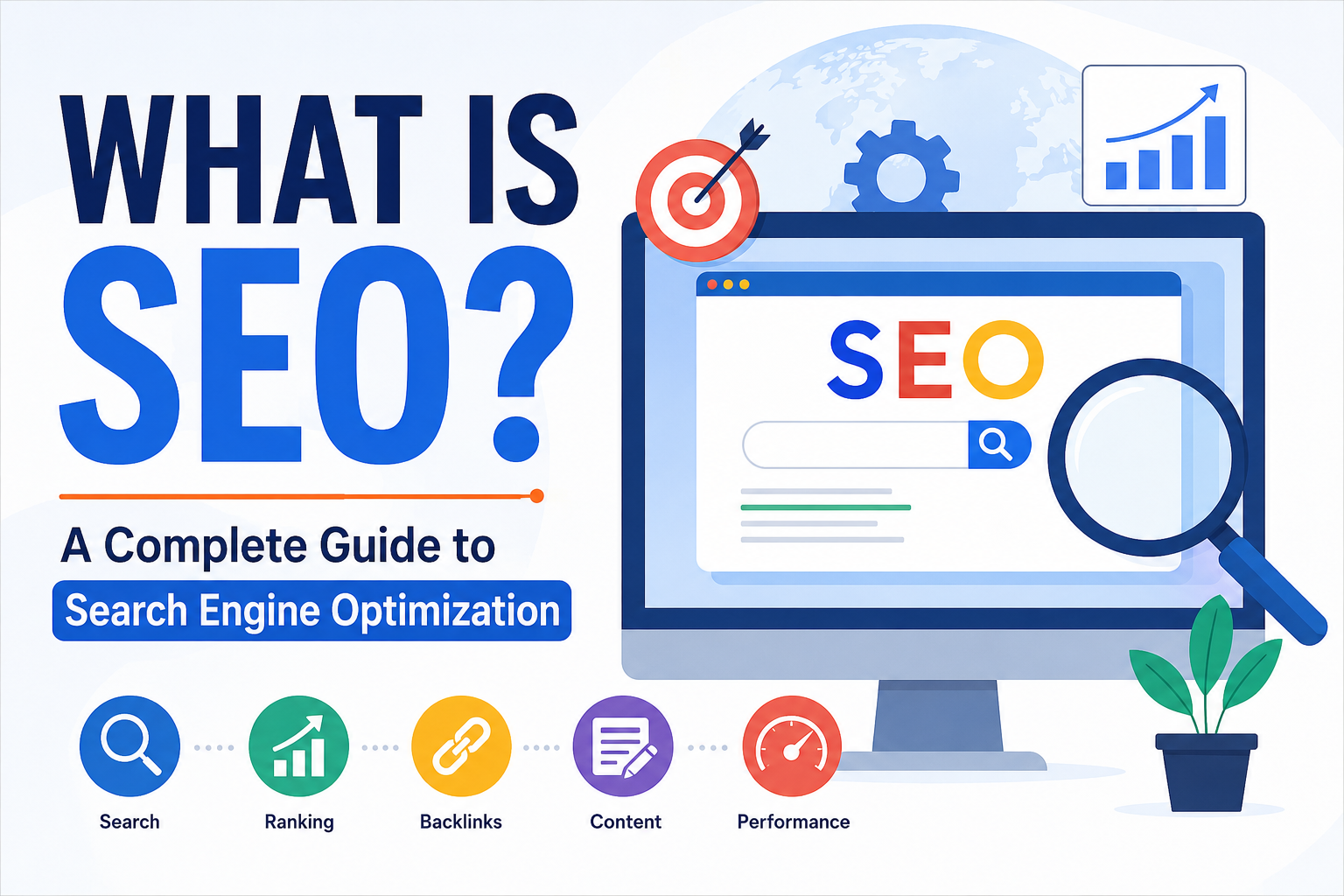
Have you ever wondered why some websites appear at the top of Google when you search for something online? The answer is often SEO. If you are new to digital marketing, you may be asking, what is SEO and why is it important for a website?
SEO stands for Search Engine Optimization. It is the process of improving a website so that search engines can understand its content and users can find it through relevant search queries. SEO can help businesses improve their online visibility, attract organic traffic, and reach potential customers.
In this guide, you will learn what does SEO stand for, how SEO works, its main types, benefits, and basic SEO techniques for beginners.
What Does SEO Stand For?
What does SEO stand for? SEO stands for Search Engine Optimization.
It refers to the process of optimizing a website and its content to improve its visibility in organic search engine results. When a website is properly optimized, search engines can better understand what the website and its individual pages are about.
For example, imagine you own a digital marketing agency and provide SEO services. You may want your website to appear when someone searches for terms related to your services. SEO helps you optimize your website around relevant topics and search queries.
However, SEO is not simply about adding keywords repeatedly. Your content should provide useful information and satisfy what the user is looking for.
How Does SEO Work?
Understanding how SEO works starts with understanding how search engines process websites.
Search engines discover webpages, analyze their content, and decide which pages are most relevant to a user’s search. SEO helps your website communicate its topic clearly and makes the website easier for both search engines and visitors to understand.
The basic process includes three important stages:
Crawling
Search engines use automated programs called crawlers to discover webpages. Crawlers can find new pages by following links from other webpages.
Indexing
After discovering a webpage, the search engine analyzes and stores information about that page in its index. This allows the page to be considered for relevant searches.
Ranking
When someone enters a search query, the search engine evaluates relevant webpages and determines which results should appear. Many factors can influence rankings, so websites need useful content, a clear structure, and a good user experience.
What Are the Main Types of SEO?
SEO includes several areas that work together to improve a website’s search visibility.
On-Page SEO
On-page SEO focuses on elements that you can optimize directly on your website.
These include:
Keywords
Page titles
Headings
Meta descriptions
Content structure
Image ALT text
Internal links
Content readability
Using these elements properly helps search engines understand the topic of your webpage.
Off-Page SEO
Off-page SEO focuses on activities outside your website that can support its authority and credibility.
Backlinks are an important part of off-page SEO. A backlink is a link from another website to your website. Relevant and trustworthy links can help strengthen a website’s authority.
Technical SEO
Technical SEO focuses on the technical parts of a website that affect crawling, indexing, and user experience.
Some important areas include:
Website speed
Mobile responsiveness
Website structure
Crawlability
Indexing
XML sitemap
Website security
A technically optimized website makes it easier for search engines to access and understand its pages.
Local SEO
Local SEO helps businesses appear in searches related to a specific location.
For example, a business serving customers in Faridabad may optimize its website and online presence for relevant local searches. Local SEO can help businesses connect with people who are searching for nearby products and services.
Why Is SEO Important?
SEO is important because search engines are one of the major ways people discover information, products, and services online.
A good SEO strategy can help a business:
Increase organic website traffic
Improve online visibility
Reach a relevant audience
Generate potential leads
Build brand awareness
Support long-term online growth
SEO can be especially useful for businesses that want to attract people who are already searching for their products or services.
Unlike paid advertising, organic search traffic does not require paying for every individual click. However, SEO requires consistent effort, useful content, and regular optimization.
What Are the Benefits of SEO?
SEO offers several benefits for websites and businesses.
Increases Organic Traffic
When your webpages appear for relevant searches, more people may visit your website through organic search results.
Improves Online Visibility
SEO helps your website become more visible to people searching for topics related to your business.
Builds Credibility
Websites that consistently provide useful and relevant information can build trust with their audience.
Supports Long-Term Growth
SEO is a long-term digital marketing strategy. Consistent optimization and quality content can help a website maintain and improve its online presence over time.
Basic SEO Techniques for Beginners
If you are learning SEO for the first time, start with the basics instead of trying to implement everything at once.
Perform Keyword Research
Find out what your target audience searches for on Google. Choose relevant keywords that match your content and the user’s search intent.
Create Helpful Content
Write content that answers the user’s question clearly. Avoid adding unnecessary information just to increase the word count.
Use Proper Headings
Organize your content with a clear heading structure. Use one H1 for the main title and H2 and H3 headings for different sections.
Optimize Images
Use meaningful image file names and descriptive ALT text. Compress images to help maintain a fast-loading website.
Add Internal Links
Link to relevant pages on your own website. Internal links can help users discover more content and help search engines crawl your website.
Use Trusted External Sources
When appropriate, link to reliable external websites that provide useful information. This can add credibility and context to your content.
Common SEO Mistakes to Avoid
Learning SEO also means understanding what you should not do.
Keyword stuffing: Repeating a keyword too many times can make content unnatural and difficult to read.
Ignoring search intent: Your content should answer the question behind the user’s search.
Poor-quality content: Content should be useful and informative rather than created only for search engines.
Ignoring mobile users: Your website should work properly on mobile devices.
Slow website speed: Large images and unnecessary website elements can affect loading speed and user experience.
SEO and Digital Marketing
SEO is an important part of digital marketing, but it is not the only digital marketing strategy.
Businesses can combine SEO with Google Ads, social media marketing, content marketing, email marketing, and other channels.
For example, SEO can help a business build organic visibility, while Google Ads can provide paid visibility. Using different digital marketing channels together can help businesses reach customers at different stages of their buying journey.
Conclusion
So, what is SEO? SEO is the process of optimizing a website and its content to improve its visibility in organic search engine results.
Now that you know what does SEO stand for and how does SEO work, you can begin learning the different areas of SEO, including on-page SEO, off-page SEO, technical SEO, and local SEO.
The key to successful SEO is to create useful content for people, use keywords naturally, maintain a clear website structure, and continuously improve the overall user experience.
Learn Digital Marketing with Vidya Sarthi Institute of Digital Marketing
Want to learn SEO and build practical digital marketing skills?
Vidya Sarthi Institute of Digital Marketing can help you develop essential digital marketing knowledge through structured learning and practical guidance.
Learn SEO, Google Ads, social media marketing, and other important digital marketing skills to prepare yourself for a career in the digital marketing industry.
Start learning today and take the next step toward your digital marketing career.
CTA: Enroll Now